Immigration law firm SEO: we put them above USCIS.gov
Picture someone with a green card interview on Tuesday. It is late, they cannot sleep, and they open Google and type “immigration interview questions.” The first thing they see is our client's guide. Below it sits Reddit, then the US government. That is the moment a frightened person decides who to call, and this firm owns it.
What that search looks like right now
These are straight off Google, not our drawing of it. We checked signed in and signed out and got the same order both ways.
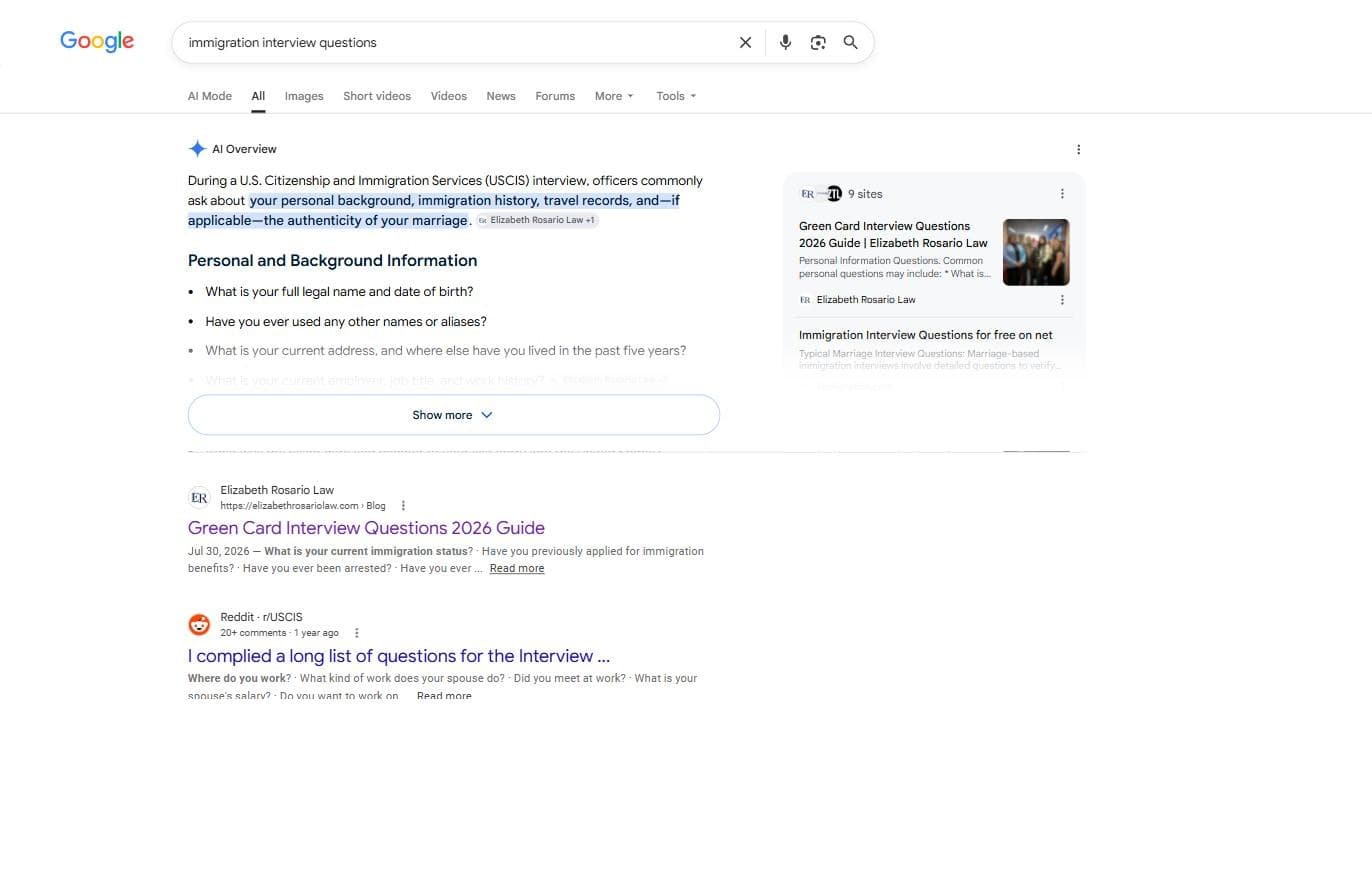
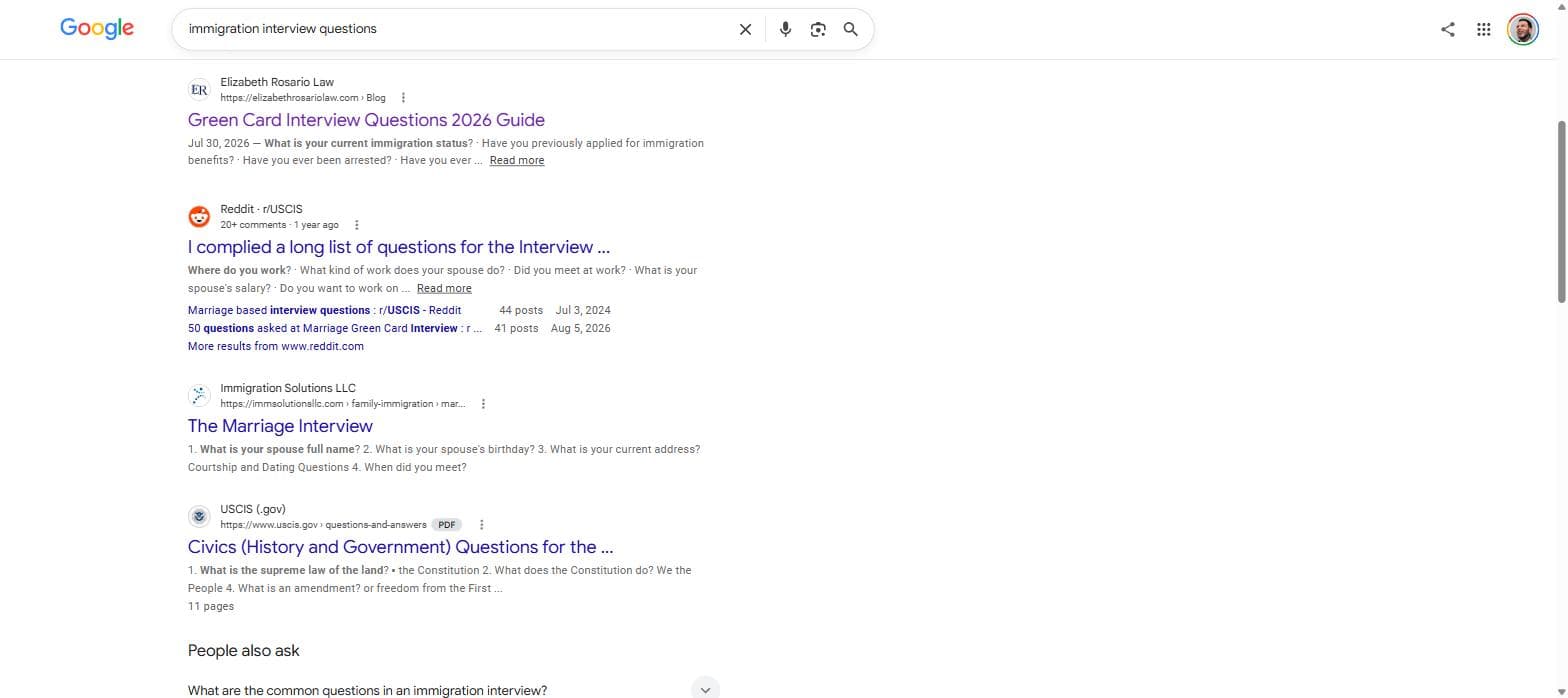
Search “immigration interview questions” yourself. Rankings move, so if this has changed by the time you read it, we would rather you caught it than took our word.
The person searching has a date on the calendar
Every immigration firm in the country is fighting over “immigration attorney.” It is expensive, it is crowded, and the person typing it is still shopping around.
The person asking what happens at their interview is not shopping. They have a case, a date, and a knot in their stomach. Answer that question well and you are the firm they already trust by the time they pick up the phone.
Google Search Console counts 1,126 clicks from that one topic, out of 20,872 times the firm appeared for it. Those are measured clicks from Google, not an estimate from a tool. Across everything, Search Console has logged 13,700 clicks and 989,000 appearances in the last sixteen months.
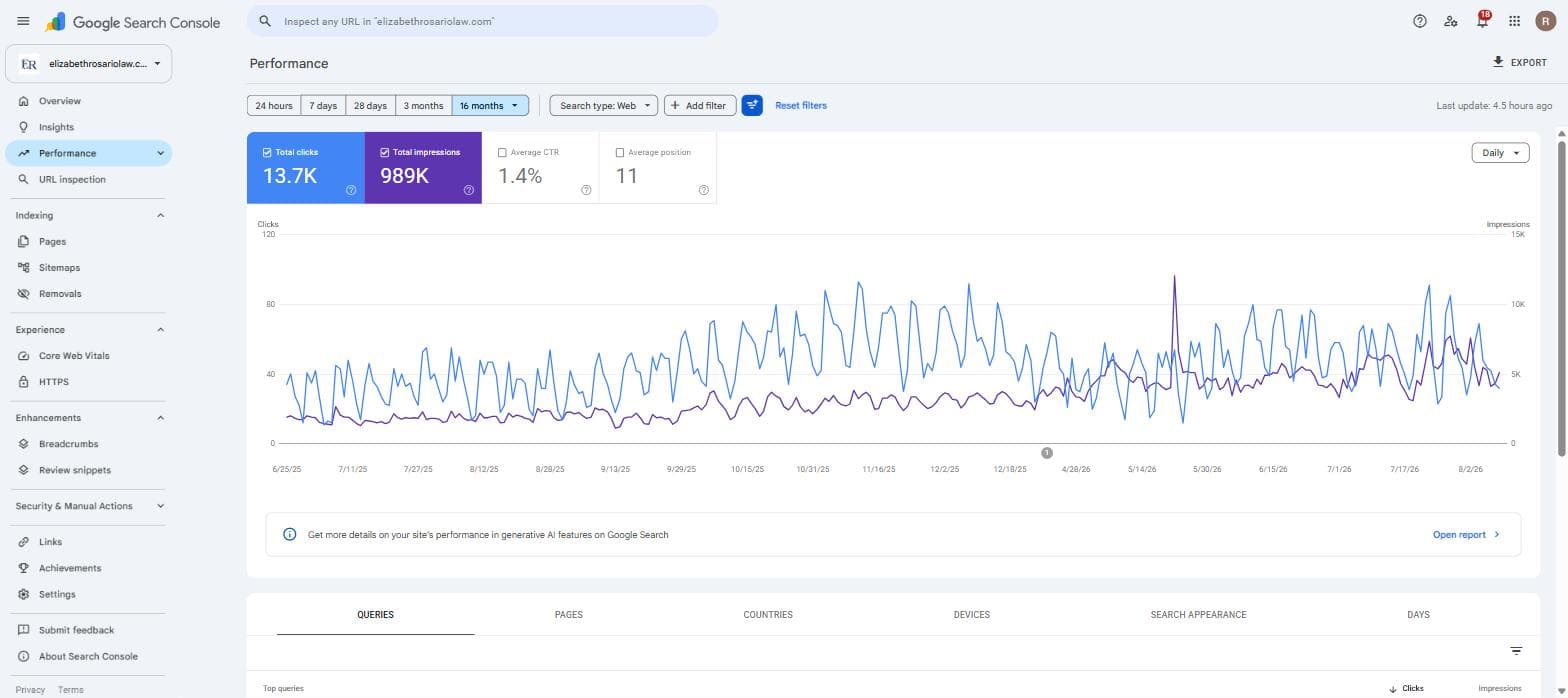
None of this existed
We took over search for this firm on 2 June 2025. The site pulled roughly 950 visits a month from Google and showed up for 482 terms, most of them versions of the firm's own name. If you already knew who they were, you could find them. If you did not, they were invisible.
The site itself was the bigger problem. Slow. Nothing like the brand. Half translated, some pages in Spanish and some not, which is worse than committing to one. Almost no search traffic and very few form fills to show for it.
And they had a problem most firms do not. Immigration is a national practice, so the competition is not the office down the street. It is Avvo, FindLaw, and content operations with ten years of head start, plus the federal government publishing the same information for free. Outspending that was never going to work.
Half their clients search in Spanish and the site served them about half the time. That turned out to be the opening.
In the order we did it
Two or three new pieces a month for fourteen months. Not a campaign, a habit. Here is what that looked like in practice.
Worked with what was already there
Before proposing anything expensive, on-page fixes and link work on the content the firm already had. You find out what a domain can actually do before you ask a client to pay for a rebuild. It also meant the rebuild, when it came, was an argument backed by numbers instead of an opinion.
Rebuilt the site, because the old one could not carry it
It was slow. It looked nothing like the brand. It was half translated, some pages in Spanish and some not, which is worse than picking one. Almost no search traffic and very few form fills. There is no amount of good content that ranks on a foundation like that, so we replaced it.
Built the Spanish side properly, on purpose
Half this firm's clients search in Spanish and the old site served them about half the time. Real Spanish pages on their own addresses, including a Spanish blog, treated as a market rather than a translation job. It is now the second busiest entry point on the site.
Went after the interview question deliberately
Keyword research kept pointing at the same thing: people search for what happens at the green card interview far more than they search for a lawyer. We targeted it on purpose and wrote the best answer on the internet. That one guide now shows up for 326 searches and is what Google quotes in its AI answer.
City pages with actual local detail, plus citations
A shared structure for consistency, then real specifics for each place, because a template with the city name swapped fools nobody and ranks accordingly. Directory and legal citations went in alongside them. One city page pulls 61 searches by itself.
Wrote so the AI engines could quote it
Direct answers near the top, clean structure, proper schema, so the useful part is easy to lift. Fifty pages are now cited across ChatGPT, Gemini, and Google's own AI answers, and the firm is the most quoted source on its own topics.
One thing we did not do: chase links
- We never ran an outreach campaign. Not one pitch email.
- Content earned links on its own once it started ranking.
- Directory and legal citations did the rest of the heavy lifting.
- Internal linking tied it together so authority moved around the site.
Referring domains still went from 111 to 227. If an agency tells you link building is the product, ask them what happens when they stop paying for it.
How do you outrank the government?
USCIS and the State Department publish this information for free, with the most trusted domains in the country. You do not beat that on authority. You beat it on being more useful.
Answer the real question
The government documents policy. A person facing an interview wants to know what is going to happen to them, in plain language. Those are different jobs and only one of them is being done well.
Be readable
USCIS publishes PDFs and legal prose. We published scannable answers. Same information, and one of them is usable on a phone at midnight.
Stay current and specific
Government pages sit still for years. Ours carry the current year and the detail that static pages never do.
Serve the Spanish speaker
Federal content is noticeably thinner in Spanish. That is half this audience, and it is the widest gap on the whole board.
They stopped being invisible
June 2025 on the left, today on the right.
Doubling the count is easy. Climbing is the hard part.
Anyone can add a thousand terms nobody will ever see. What matters is where they land. The group sitting in positions four through ten grew more than four times over, and the group just behind it grew more than five times. That is a bench of pages one step from the first page of Google.
- Top 3 · 14 to 26
- 4–10 · 36 to 149
- 11–20 · 40 to 227
- 21–50 · 136 to 425
- 51–100 · 127 to 192
- Other listings · 129 to 102
We already built their software and their website
This is the same firm behind two other case studies here. We built their case management system running 7,000 live cases, and the bilingual website that now takes calls from all 50 states. That website is the rebuild described above, so the search work and the thing it runs on were never at odds.
It also means nobody had to be talked into anything. When the data said the old site was the ceiling, we could say so and then go fix it, instead of filing a ticket with whoever built it and waiting.
One note on the numbers above. Click figures come from Google Search Console, which counts what actually happened. Ranking and link figures come from Semrush. We say which is which, we date everything, and the domain is right there if you want to check us.
You do not need 50 states for this to work
A roofer in Muskegon needs fewer pages than a national law firm. The thinking is the same.
What question do your customers ask first?
Tell us and we will show you who owns the answer today, and what it would take to be there instead. Free audit, real numbers, no pitch.
Get Your Free AuditInstant score · No sign-up · Under 30 seconds