Pepper's Pressure Washing can finally see which marketing books jobs
Pepper's Pressure Washing & Window Cleaning has been a Charleston favorite for over a decade, with hundreds of five-star reviews and a calendar that mostly fills itself. What they didn't have was any way to see which marketing actually produced paying jobs. We built the instrumentation: a fast new site, local SEO, lead attribution wired into their CRM, and conversion tracking from the first click to the booked job.
What changed
Pepper's revenue is their private business, so this case study leads with capability, not figures. Each item below is something the engine we built does now that it couldn't before.
A beloved Charleston brand with a blind spot
Pepper's Pressure Washing & Window Cleaning is a residential exterior-cleaning company serving the greater Charleston, South Carolina area: house washing, roof cleaning, driveways, gutters, and windows. Owner-operated for over a decade, with hundreds of five-star reviews and a reputation that books most of the calendar on its own.
The problem was never demand or quality of work. It was visibility into their own marketing. Inquiries came in and got handled inside the CRM, but nothing connected a booked job back to the thing that produced it. No lead tracking, no attribution, no conversion data. A business doing real volume was running its marketing on instinct.
Maxx Effect was brought in to fix that, not by replacing what worked, but by instrumenting it: building the site, the SEO, and the tracking that let Pepper's see the engine instead of guessing at it.
A strong business with no way to measure its marketing
Four gaps were costing Pepper's leads and clarity. None of them showed up in revenue, which is exactly why they went unaddressed for so long.
An established brand, flying blind
Pepper's didn't have a demand problem. People around Charleston already knew the name and the work. What they didn't have was any way to see which marketing produced paying jobs. Inquiries were handled ad hoc in the CRM, and the trail stopped there.
A lead leak nobody could see
The old site's quote form had a bug that silently dropped submissions. No operator could have caught it: with no event logging behind the form, nothing ever looked wrong. The leads simply never arrived.
No attribution, no feedback loop
Without UTM tracking or channel attribution, organic, paid, and referral traffic all looked the same. There was no way to separate a marketing dollar that worked from one that didn't, so every spend decision was a guess.
Plenty of local demand, barely there in local search
Strong word-of-mouth across the Charleston area, but a limited structured presence for the searches people actually run: service by service, neighborhood by neighborhood. The reputation was real; the search visibility hadn't caught up to it.
What we built, and how it connects
Six pieces, each one chosen so that a marketing dollar can be traced to a booked job. A site that converts, SEO that keeps growing, and tracking that connects the two.
A conversion-first website
A fast Next.js marketing site built to turn a visit into a booked quote. Calls to action above the fold on every page, click-to-call for mobile taps, a sticky call bar, and a dedicated quote flow instead of a buried contact form.
Technical and local SEO, by the service area
Structured data for LocalBusiness, services, and FAQs, plus an internal-linking architecture that ties the whole site together. A page for each service and each city Pepper's covers, an ongoing blog, and optimization for AI-driven search, so the site keeps earning visibility instead of standing still.
Lead capture and attribution, into their CRM
Quote forms wired straight into HouseCall Pro, with first- and last-touch UTM and channel attribution attached to every submission and a durable event log behind it. We also root-caused and fixed the old form's lead-capture bug, so every submission now lands as a lead.
Conversion tracking, end to end
GA4 lead events, a dedicated thank-you page as a clean conversion point, Consent Mode v2 for privacy-compliant measurement, and Google Ads conversion tracking wired to the same events. One source of truth from click to booked job.
Paid search, built to be measured
A Google Ads search campaign with researched keywords, responsive ad copy, and a negative-keyword strategy, so the budget goes to searches that actually convert rather than ones that just spend.
Lead-to-job reporting
We pulled their CRM job history and built reporting that connects leads to booked jobs. For the first time, Pepper's can see how an inquiry becomes revenue, and which channel sent it.
What Pepper's walked in with, and what we shipped
Same business, same reviews, same Charleston service area. Left is the site Pepper's ran before the rebuild, from the Wayback Machine's archive. Right is the conversion-first site running today. Both are real captures, not mockups.
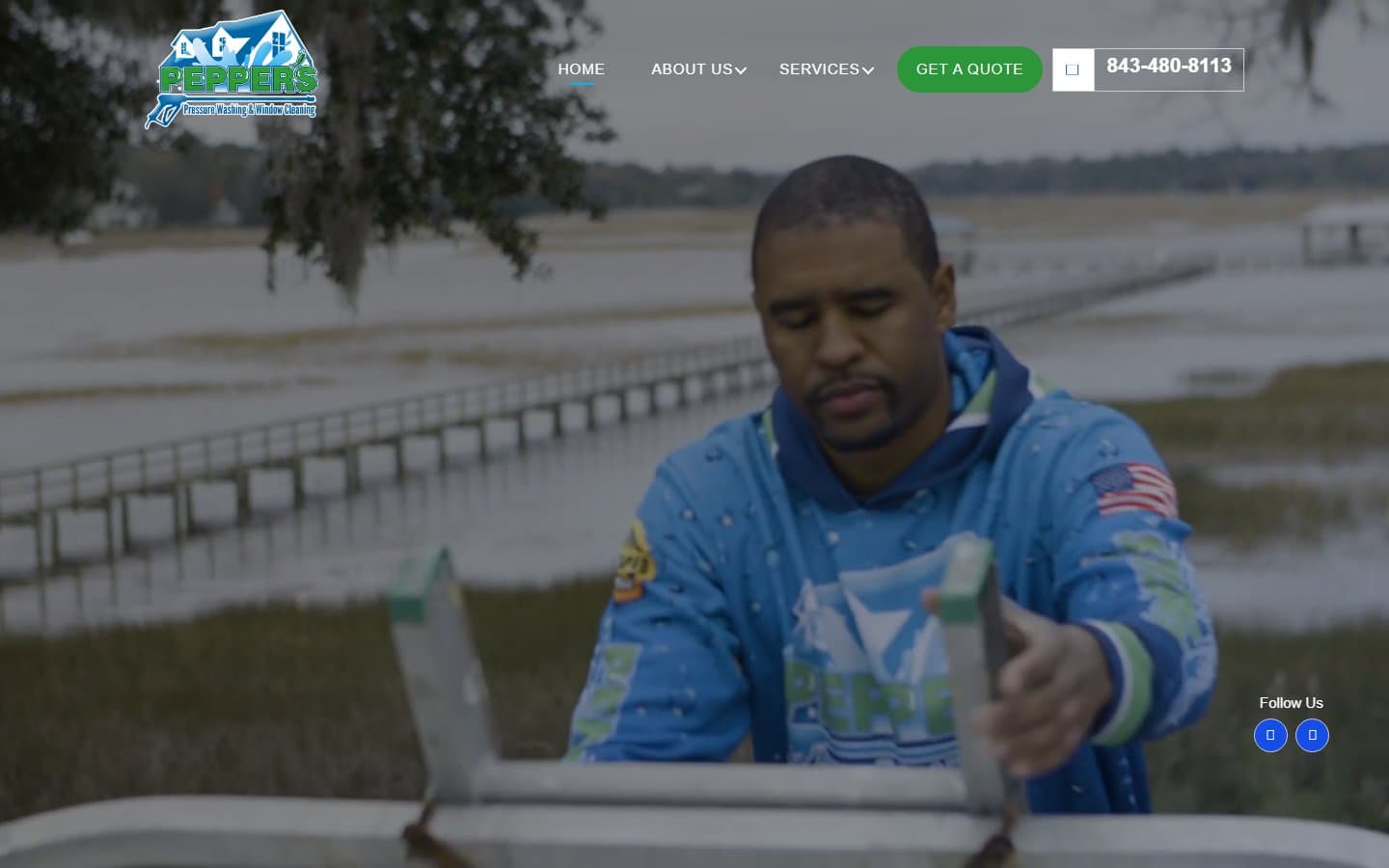
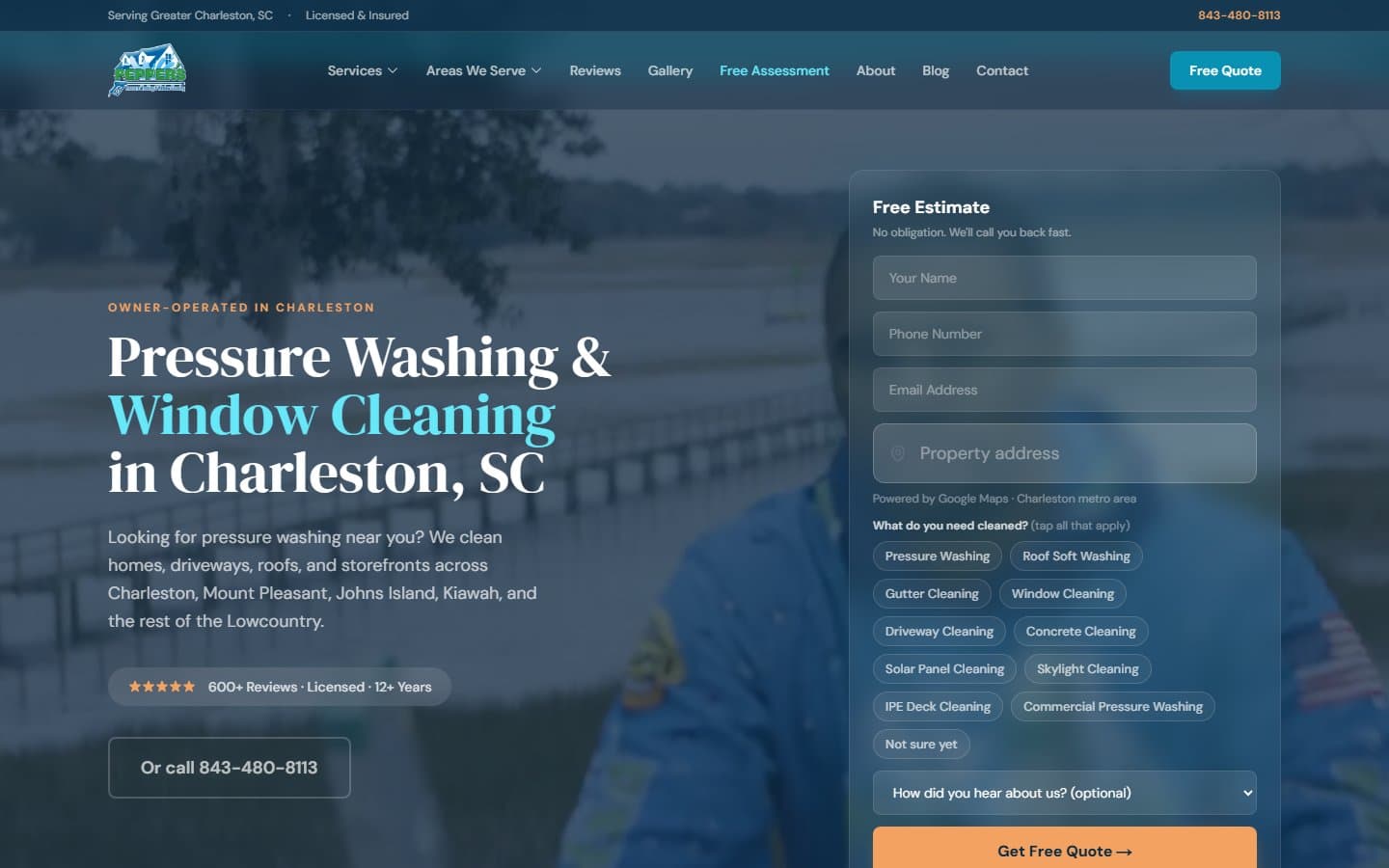
The whole page, top to bottom
The hero is where the click lands. Everything below it decides whether the visit becomes a quote. Left is the old site, right is the site running today.


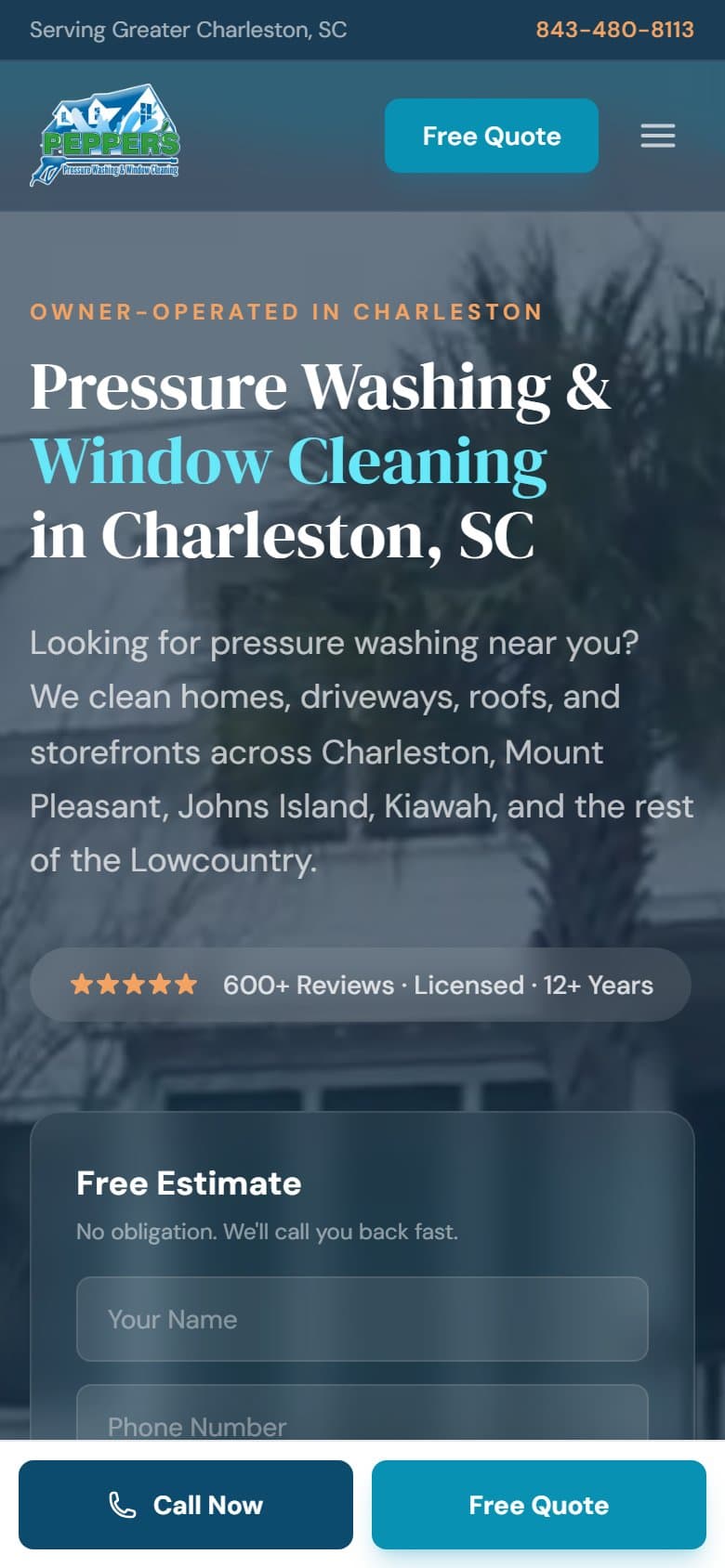
Most pressure-washing searches happen on a phone
A homeowner standing in the driveway, or a neighbor's referral typed in at the kitchen table. The new site is built mobile-first: click-to-call within reach, the quote form a thumb-scroll away, and fast on a cellular connection.
The whole stack
The same Next.js + Vercel foundation behind every Maxx Effect build, with the attribution and conversion-tracking layer that turns a marketing site into a measurable system.
From running on instinct to running on data
The real change is visibility. Before, Pepper's ran marketing on a strong reputation and a full calendar, with no way to tell which efforts were doing the work. Now every inquiry is captured, attributed to a channel, and tied to whether it became a booked job. That is the difference between hoping marketing works and knowing which part of it does.
The early signals point the right way. In the first weeks of tracking, a meaningful share of website leads turned into booked jobs, and organic search came out as the best-converting channel of any source. We treat those as leading indicators rather than a finished verdict: the site launched recently and the tracking window is still short, so the direction matters more than any single reading.
The wider context is good, and we're careful about what we claim within it. This year is on track to be Pepper's strongest on record, on their highest job count yet. A beloved brand with a decade of word-of-mouth was always going to carry momentum, and the engine we built has only been running a few months, so we don't hang that result on our work. What we can say plainly is that Pepper's now has a measurable, system feeding that growth that builds on itself, and the leading indicators coming out of it are pointed in the right direction.
From here it builds. Rankings grow as content and city pages accumulate, paid search sharpens as conversion data feeds back into it, and the lead-to-job reporting gets more useful every month it runs. The next phase is simple: keep feeding the engine and let the attribution data steer the budget.
The same engine scales to any local service business
You don't need a decade of reviews to run marketing you can measure. Each piece below maps onto trades, home services, and local shops at small-business prices.
Run a pressure washing company?
This build is the proof behind our pressure washing vertical. The conversion-first site, local SEO, and lead attribution that drive Pepper's are packaged for exterior-cleaning companies. See the pressure washing offer, from $2,500.
Open the pressure washing pageThe deep dives this build backs up: pressure washing SEO, pressure washing leads, and pressure washing website design.
Want marketing you can actually measure?
Every engagement starts with a free audit. We look at your site, your channels, and your CRM, then send back a concrete plan for turning traffic into booked jobs. No pitch, no pressure.
Get Your Free AuditInstant score · No sign-up · Under 30 seconds